History of Games 2026
Conference theme: The Ages of Games. Epochs and Periodisations
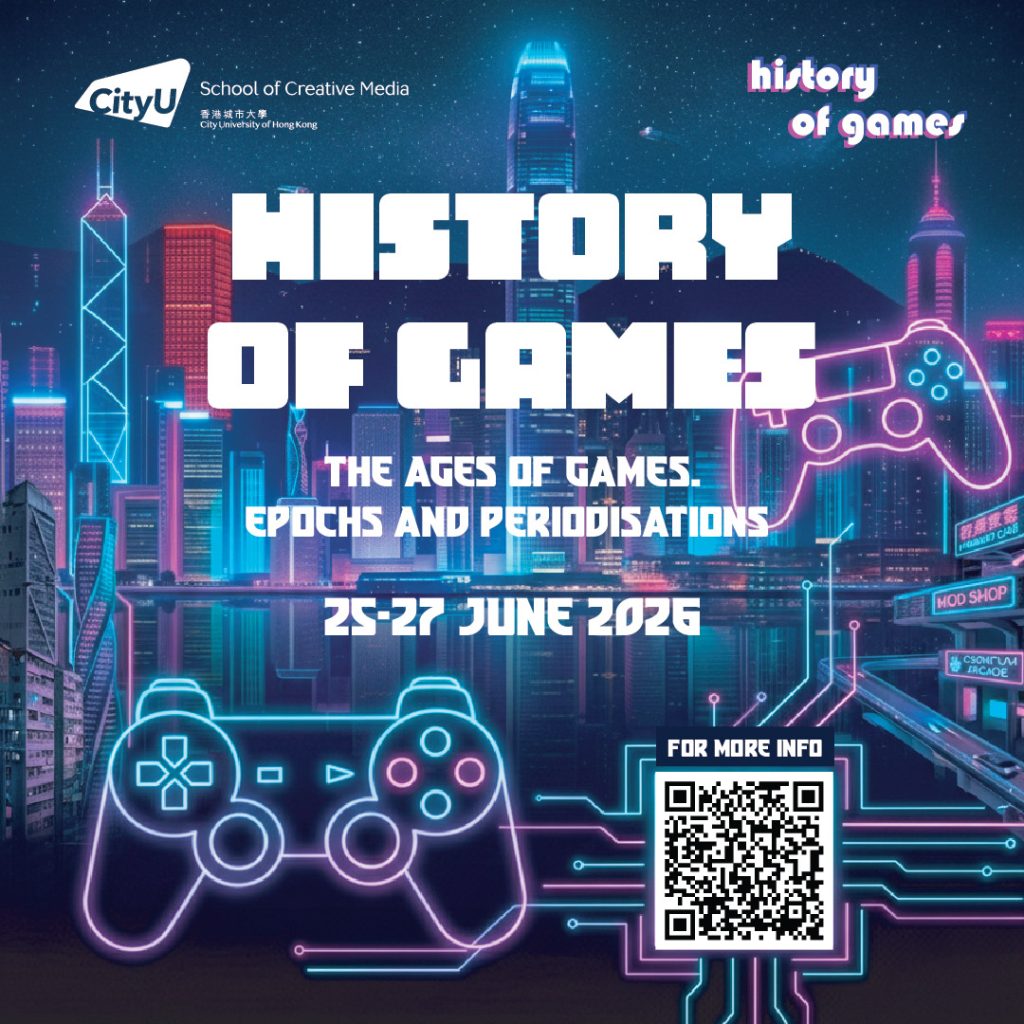
25–27 June 2026 • CityU Hong Kong
2 July 2026 • online
➡️ History of Games 2026 Programme
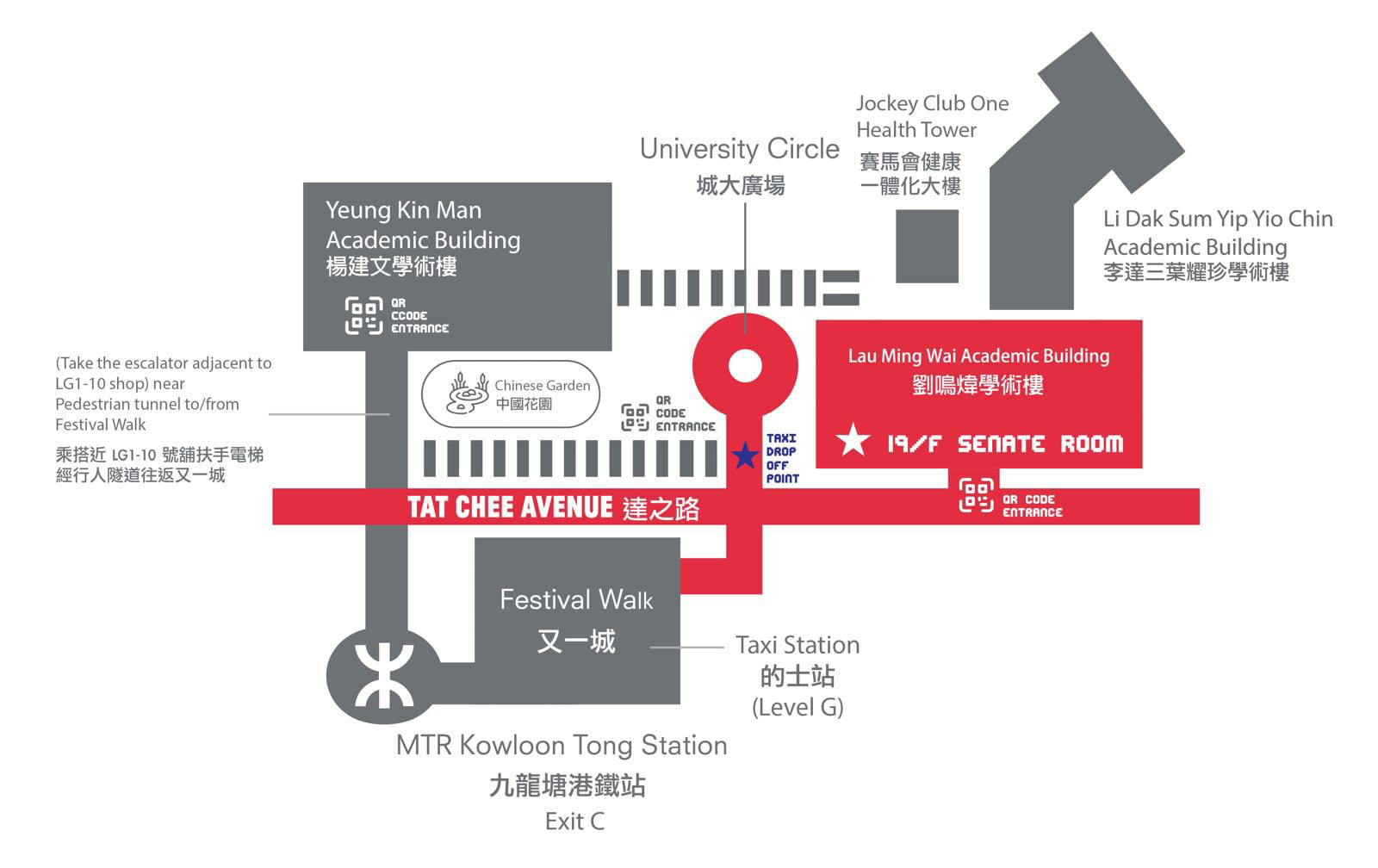
Conference Venue:
Senate Room and Room 19-202
Level 19, Lau Ming Wai Academic Building
City University of Hong Kong
Google map to Lau Ming Wai Academic Building (link)
Catering Options:
CityU Catering Outlets:
https://www.cityu.edu.hk/directories/catering
Festival Walk (a nearby shopping mall): https://www.festivalwalk.com.hk/en/dining
Visitor QR Code:
All presenters will receive a visitor QR code by Wednesday, June 24th through an email from CityUHK. Upon arrival at CityUHK, visitors will need to click the link in the email to generate a real-time visitor QR code. Scan the code at the campus entrance gate.
https://www.history-of-games.com/2026-hong-kong/
https://www.scm.cityu.edu.hk/events/history-of-games-2026
History is often divided into epochs, be they ages, periods, dynasties or eras. The history of popular culture is no different: cinema, for example, has the cinema of attractions, the silent period, the age of vanguards, post-war movements such as the New Waves or the Italian Neorealism, the New Hollywood, the age of V-Cinema and OVA, and the international rise of independent films. Similarly, games and video games have Golden Ages, revolutions, generations, crashes, and many other popular ways to identify discrete segments of their own histories. To study the history of games is to think about epochs defined by shared traits and bookended by transformative events.
How is this periodisation done, and by whom? Who are the stakeholders of this conceptualisation? What are the main criteria to define periods? How does the concept of epochs differ between the spheres of academia, criticism, and popular gaming culture? Epochs can be proposed and accepted by the public according to technology, impact of/on other areas outside of the medium, and even artistic trends and movements. They often tell a unified story that is useful in simplifying the ebbs and flows of the history of the medium, but can hide key events, actors, and regions.
For History of Games 2026, we invite you to consider periodisation: for example, already established and accepted periods, alternative ones, problematisations of epochs or international and regional periods and their coexistence. What are the best ways to discuss gaming’s epochs, and what methods can be used to anchor them? What can we learn (and unlearn) by questioning these ages of games? Possible topics include, but are not limited to:
- The periodisation of games culture: events, magazines, communities
- Regional periods, their differences and similarities with “universal” history
- The periodisation of genres
- Key historical elements ignored by popular periodisation
- Grey markets and their (lack of) periodisation
- The epochs of historiography, preservation, and collecting
- The concept of “classic” in games history and culture
- Fan periodisation
- Key events and elements of history for periodisation
- Technology and periodisation
- The impact of and on games as a periodisation criterion
- Epochs and canon(s)
- Art and artistic movements in the periodisation of games
- Representation of periods in games, e.g. Graeco-Roman elements in contemporary games
- Hardware cycles/generations as periodisation (e.g. consoles, PCs, arcades, mobile gaming, etc.)
- Periods of monetisation: from sale to free-to-play
- “Periods” of specific ongoing games: e.g. World of Warcraft major patches
Submissions
Submissions of a 500-word abstract (excluding references) to the Histories of Games 2026 conference are welcome and will be double-blind peer-reviewed. Please make sure the submission is anonymous and that references to your own work, if used, are included in a way not allowing the identification of the author (i.e. avoid saying “in my previous work [citation]”).
Please note that to ensure equity and access to the conference, no author may present more than two contributions to the conference. This includes single- and joint-authored submissions.
Submissions should be sent here: https://www.history-of-games.com/openconf/openconf.php
Important dates
Submission opens: 2 Feb 2026
https://historyofgames.site/openconf/openconf.php
Submission Closes: 10 March 2026, 23:59 AOE (extended deadline)
Notifications of Acceptance: Sent to authors by 10 April 2026
Conference: 25-27 June 2026 (CityU, Hong Kong) and 2 July (online)
Participants will have the option to select an online presentation when registering. Further details to follow, including conference fees, news on our keynotes and more!
Updates will be available at https://www.history-of-games.com/2026-hong-kong
Keynote Speakers
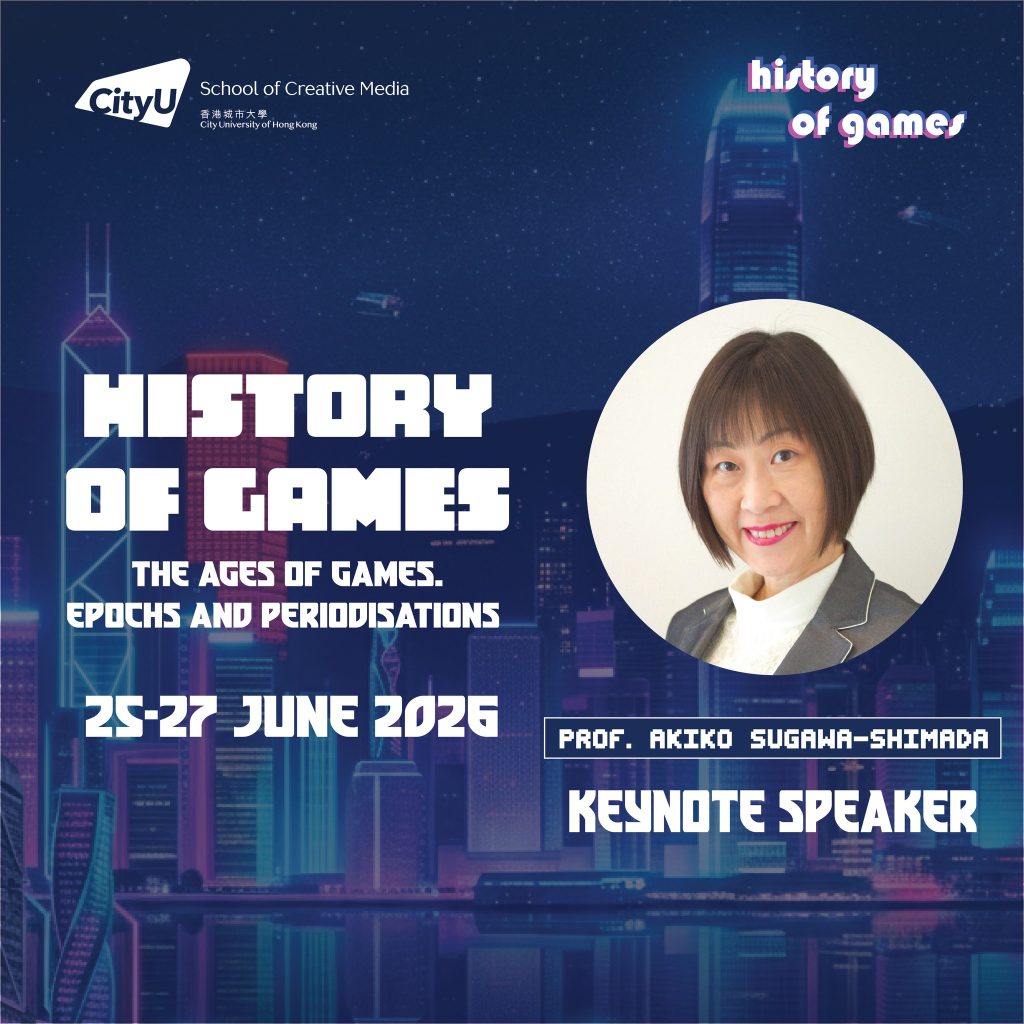
Prof. Akiko Sugawa-Shimada
Professor, Graduate School of Urban Innovation, Yokohama National University
Akiko Sugawa-Shimada, PhD, is a professor in the Graduate School of Urban Innovation at Yokohama National University, Japan. She is the author of a number of books and articles on anime, manga, and Cultural Studies, including Girls and Magic (2013), 2.5-dimentional Culture (2021), Introduction to 2.5D Studies (2024), chapters in the books Shojo Across Media (2019), Contents Tourism and Pop Culture Fandom (2020), and Animating the Spiritual (2020), Idology in Transcultural Perspective (2021), War as Entertainment and Contents Tourism in Japan (2022), Cultural Approaches to Studio Ghibli’s Animation (2022), and Mechademia: Second Arc vol. 15.2, “2.5D Culture,” (guest editor, 2023). ORCiD 0000-0002-9381-3718
Women, Japanese History, and Videogames in Japan:
Female Fans’ Heritage Tourism as Game-adjacent Cultural Phenomena
Abstract
In Japan, videogames have traditionally had a predominantly male user base, but the number of female users has been increasing since the early 2000s, when game consoles became more user-friendly. Notably, the videogame Sengoku BASARA (based on the history of the Warring States Period during the late fifteenth and late sixteenth centuries) and the girls’ videogame Hakuoki (based on the history of the Bakumatsu Period, 1853-1868, particularly the shogunal guard unit Shinsengumi) became a massive hit, particularly among women. The content was consumed across various media platforms, including anime and stage plays, and the rise of “rekijo”(history fan girls) became a social phenomenon. Recent years have seen the mobile game Touken Ranbu (2015-) and its adaptations—including stage plays and anime—become massive hits. Because Touken Ranbu features handsome male characters who are personifications of historical Japanese swords, content tourism—where fans visit the birthplaces of historical figures associated with swords from the Heian (the 8th-12th century) to the Edo periods (the 17th -19th century)—has become a social phenomenon. This keynote will explore how female fans’ consumption of game content and travel behaviors transformed the male-dominated field of games and history, shifting perceptions of women as consumers with significant economic impact.
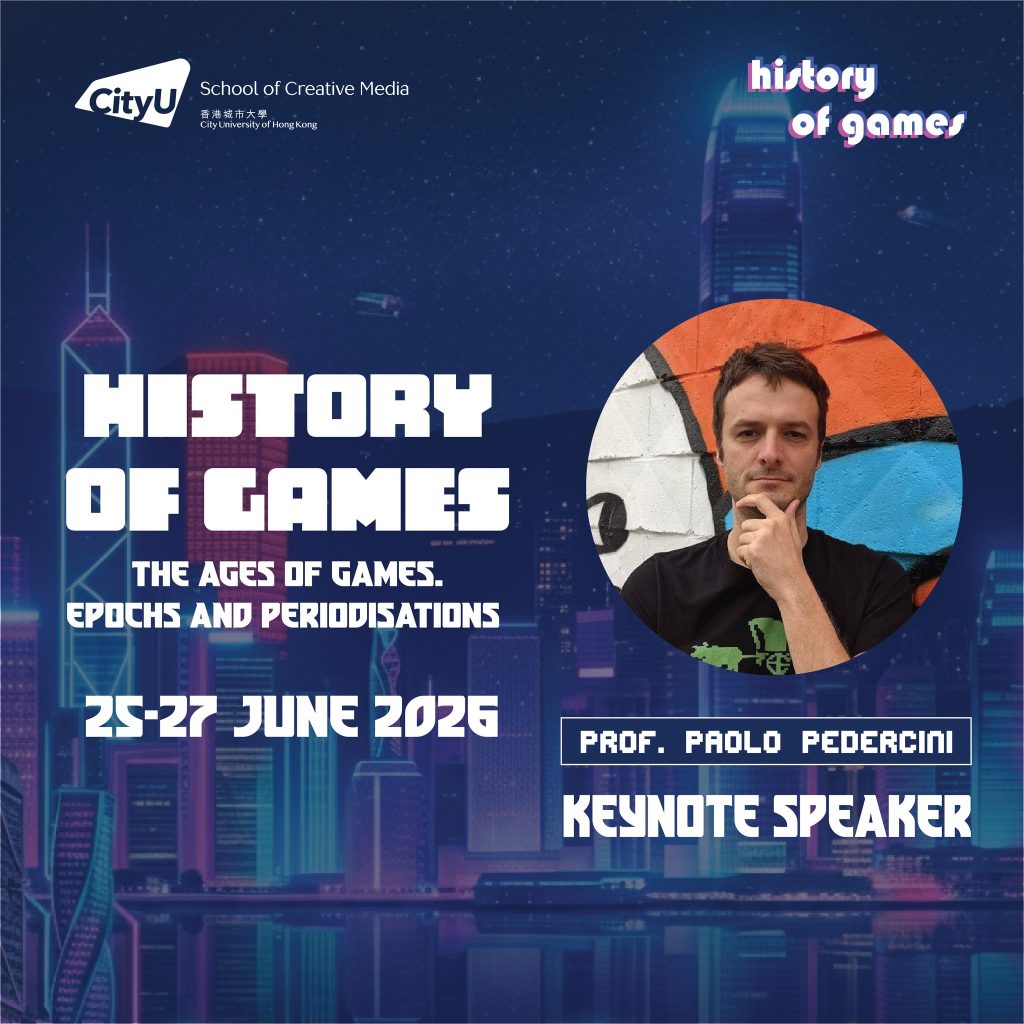
Prof. Paolo Pedercini
Associate Professor of Art, School of Art, Carnegie Mellon University
Paolo Pedercini’s work deals with the relationship between electronic entertainment and ideology. He often works under the project name “molleindustria” producing video games addressing various social issues such as environmentalism, food politics, labor and urbanism. His games are enjoyed by millions of non-art oriented people over the net and have been exhibited in art and non-art contexts all over the world.
Paolo teaches media production and experimental game design at Carnegie Mellon University in Pittsburgh, and has lectured extensively in venues ranging from the oldest squat in Italy to the Centre Pompidou in Paris.
Paolo’s work has received wide international coverage by major media including The Guardian, El Pais, BBC, Liberation, Der Standard, New York Times, Washington Post, Business Week, Playboy Brazil, ARTE’ TV, Wired, Vice among the others.
Paolo is the director of LIKELIKE, a arcade/gallery devoted to independent games and playful art in Pittsburgh, PA.
A History of Video Games Through Mass Extinctions
Abstract
This talk proposes a materialist periodization of video game history through moments of crisis, collapse, and “mass extinctions.” Revisiting canonical turning points – including the crashes of 1977 and 1983, the decline of arcades, the publisher consolidation of the mid-1990s, and the rise of independent games – it asks not only what parts of the industry survived these ruptures, but what kinds of games, production models, and cultural possibilities disappeared or emerged as a result.
Drawing on the perspective of a game developer, this talk argues that these crises reflect shifting relationships between capital, developers, and players. It further examines the recent wave of layoffs and the challenges of independent game-making in a ruthless attention economy, suggesting that the current restructuring signals a broader deprofessionalization of game development. It concludes by speculating that the ongoing “Game Industry Reset” may mark the end of a consolidated era for the Western game industry, which raises new questions about the future of games as cultural production beyond the imperatives of profitability.
Programme Committee:
Tomasz Majkowski, Jagiellonian University, Kraków
Regina Seiwald, University of Birmingham
Souvik Mukherjee, Centre for Studies in Social Sciences, Calcutta
HaJo Backe, ITU Copenhagen
Local Organising Committee:
Espen Aarseth, CityUHK (conf chair)
Leon Xiao, CityUHK
Peichi Chung, Chinese University of Hong Kong
Ben Horn, Hong Kong University
Johnathan Harrington, Hong Kong Baptist University
Jussi Holopainen, CityUHK
Morgan YU Hao, CityUHK
Rhys Jones, CityUHK
Man Shun Malina Siu, CityUHK